Monday, 21 January 2013

The Square and Semicircle Book


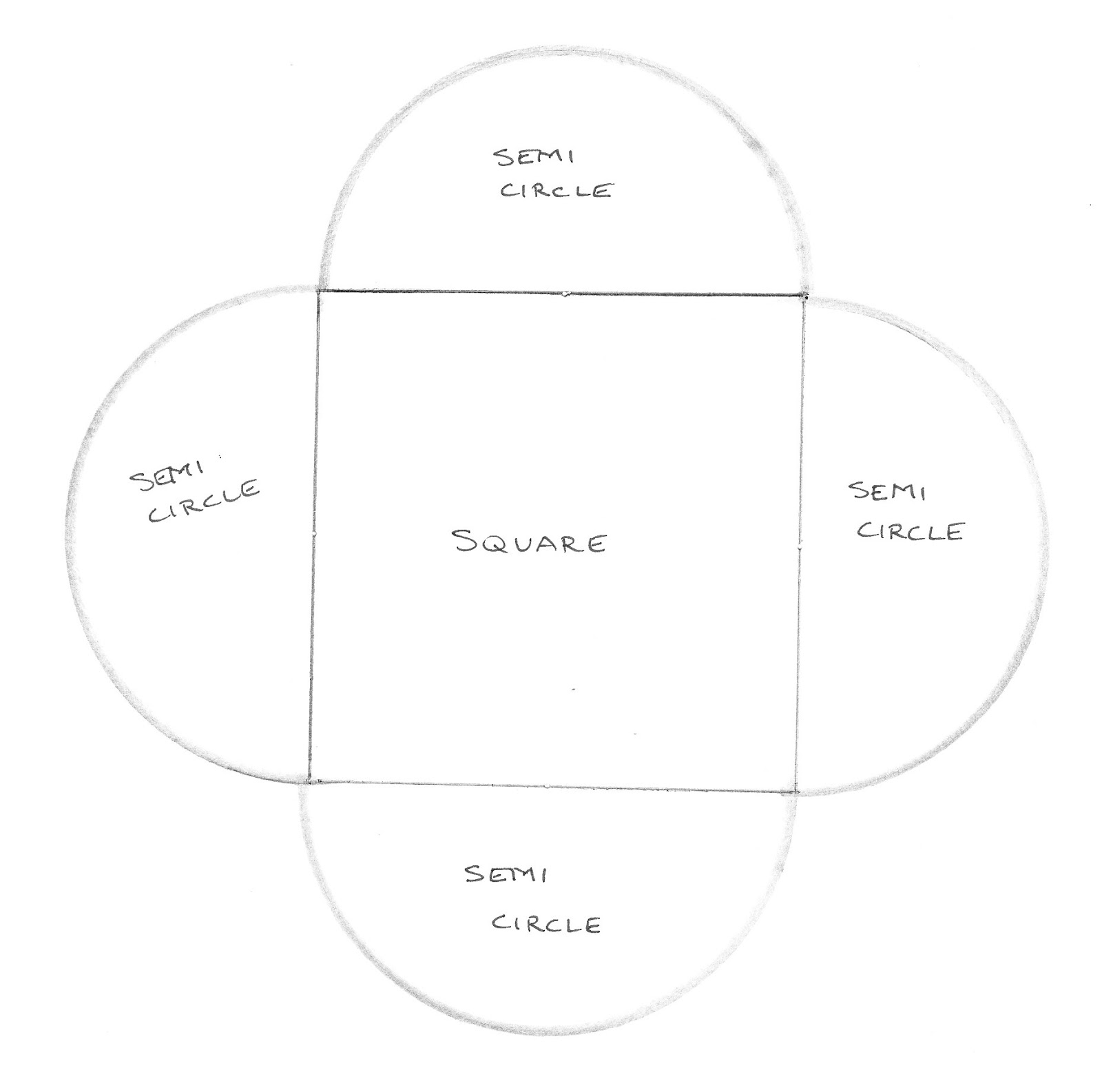
A Book is like a Garden in the Pocket (1997), like the box, was made by adapting the same Japanese card structure.  I wanted to reflect geometrical parterre gardens, also a product of  ideas and ingenuity, so it was appropriate to use the square and semicircle pattern as a starting point.


Back then I was very keen to use the materials of illuminated manuscripts, and in this case I used calfskin vellum for the 'pages' and made the drawings with a dip pen and gouache.


My starting point was again the same square and circle pattern.  
I cut two squares and three semi circles out of book board.  
The vellum pages were cut slightly smaller and the spine piece in my case was about 1 cm thick. 
Because of the thickness of the book board when the three semicircles are folded on top of one another, you need to leave a gap between the square and semicircle pieces before assembling the structure, so it sits well when the semicircular pieces are folded in.
I first glued the vellum spine along its edges to the outer side of both squares.
The joins and edges were all covered in Japanese paper and the vellum pages containing the drawings
were glued onto the book in the appropriate places. 


I do a lot of work with circles and use a compass cutter which can cut circles up to 15 cm. in diameter but I also sometimes just use my favourite tool, my Fiskars scissors.


Friday, 18 January 2013

Square or Circular Book Box


The book box above was adapted from a Japanese card structure that I first saw in an old book I have called Creative Cards by Yoshiko Kitagawa, Kodansha International 1987.  The book and box above were also made a long time ago in 1997.

I used the card structure for my 2012 Christmas card and I will show how I adapted it into a book box.  The pattern for the card is based on a square with semicircular flaps.


The flaps are folded over consecutively and when you fold the last one you need to tuck it in under the first one and it looks like this.

The finished book box will also look like that. 

 I added the width of the book's spine to the pattern to create a box structure.


1.  The inner square should be the measurement of the book plus 4 mm.
2.  The width of the book's spine is added to create an outer square.
3.  A semi-circle is then added to each side and its diameter is the same length as the side of the inner square.
4.  The little squares on each corner are used as tabs.  You cut through the outer square on one side of the tab, and fold it on the other side and glue it to the wall of the adjacent side to form the sides of the box.  
5.  The semicircular flaps will then fold in as they did with the card and it will  have the same appearance except that it has depth rather than being flat.

(Thanks Di for inspiring me to write this post.)


Monday, 7 January 2013

True Grit


I've finally wound up the last of my projects for 2012 and have completed my final book for BookArtObject titled True Grit just before Christmas.  I posted the books out to members of Group 11 on the 2nd January.

The book is made up of digital prints of five linocuts with collage mounted in 3D into Canson card and shows a small fishing boat battling huge seas, a text page and a colophon.

I decided to ignore the most obvious connections to the title True Grit.  I thought the most fitting example of unfaltering courage and true grit are the asylum seekers who flee their homeland for Australia by undertaking risky journeys with people smugglers in a desperate attempt to find peace and freedom from persecution.


Sunday, 9 December 2012

Unchartered Democracy

 
Un Chartered Democracy is my second Book Art Object book using title #56 of 100 stories in Sarah Bodman's book An Exercise for Kurt Johanessen (with her permission).
 
This book takes the idea of a charter as an official written document of Government as well as a contract executed between two parties - the US Government and soldiers serving on its behalf.  A small number of US soldiers in Afghanistan have committed atrocities whilst serving their country and its promotion of democracy.  Their actions were disrespectful, unethical, unacceptable, unauthorized, unchartered.
 
 
I intended to make a thought-provoking book about the insanity of war and needless killing, the effects on young soldiers working in intolerable and stressful circumstances, and how these situations create an environment where codes of conduct are broken, and to also reflect on the innocent citizens caught up in the mess.
 
 
I used the Turkish Map Fold structure to suggest a map location in the Middle East along with Islamic patterns in soft pink on the back of the pages.
 
The music pattern of a pianola roll containing words from Stars and Stripes Forever was printed onto the pages.


The drawings depict some of the atrocities committed by a few US soldiers in Afghanistan and parts of the drawings have been hand coloured with watercolour pencil.
 
 
I have been reminded with this book that although the artist creates a book constructing meaning by reflecting their own thoughts, opinions and feelings, once it arrives in the hand of the viewer, the whole thing is recontextualised by the opinions, beliefs and knowledge each viewer brings to their reading of the book.  I would like to thank the BAO members who have received the book and written eloquent and thoughtful responses.
  

Friday, 7 December 2012

Hand Held


I'm getting a box of smallish things ready to send off next week to Megan Herring for her Christmas Exhibition at Hand Held Gallery
 
 
All works will be for sale and available for collection immediately, so if you're in Melbourne, head on down to Hand Held Gallery in Paramount Arcade, 108 Bourke Street.


Saturday, 10 November 2012

Their Name Liveth For Evermore


At the eleventh hour of the eleventh day of the eleventh month
we will remember them. 

I first made a trip to the battlefields of the Somme on the Western Front of France in 1999 on a family history trip.  A highlight was a visit to the Australian National Memorial Cemetery just outside the small town of Villers Bretonneux and I'm sharing a few photos for Remembrance Day from that trip and a second one in 2009.


The architect of the beautiful buildings on the site was Sir Edwin Lutyens. Besides about 2000  graves in the memorial, the names of 10,773 soldiers of the AIF killed in action but with no known grave are listed.


The local school in Villers Bretonneux houses the Anzac Museum and a huge sign dominates the playground - Do not forget Australia.